Coloring Book: The Font That Brings Instant Joy to Your Designs
Let's be honest: sometimes, a design project just needs a dose of unfiltered happiness. You're working on a flyer for a community fair, a logo for a children's boutique, or the cover for a self-published activity book, and the standard, serious fonts feel completely wrong. This is where a typeface like Coloring Book steps in. It’s not just a collection of letters; it’s a personality. With its hand-drawn, cheerful aesthetic, it immediately communicates fun, creativity, and a sense of approachable playfulness. Think of it as your design toolkit's resident optimist.
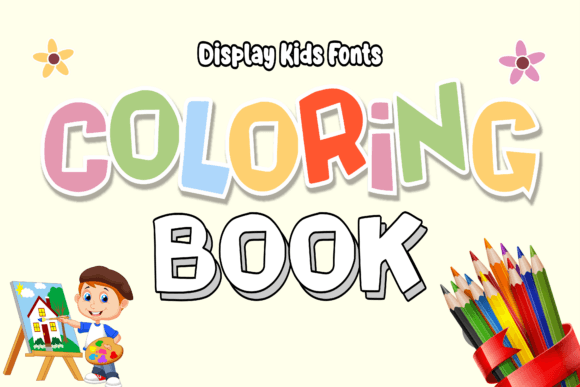
At its core, Coloring Book is a display font. That means it’s built for impact and personality at larger sizes, rather than for setting long paragraphs of body text. Its visual characteristics are unmistakable: slightly irregular letterforms that mimic the charm of hand-lettering, a bouncy baseline that gives words a lively rhythm, and a rounded, friendly feel. It avoids the starkness of a geometric sans serif font and the traditional seriousness of a classic serif font. Instead, it occupies a delightful space that feels personal and crafted, making it a powerful creative font for projects that need to connect on an emotional level.
Where This Cheerful Font Truly Shines
The real strength of a typeface like Coloring Book lies in its versatility within specific contexts. It’s not a universal workhorse, but in the right scenario, it becomes irreplaceable. For brand identity, particularly for businesses targeting families, children, education, or creative hobbies, this font can become a cornerstone. Imagine it on a logo for a toy store, the masthead of a parenting blog, or the packaging for organic baby snacks. It builds an instant, friendly rapport with the audience.
In marketing and social media graphics, Coloring Book is a standout. Its playful nature cuts through the noise of a crowded feed. Use it for headlines on Instagram posts, quotes, event announcements for workshops or markets, and call-to-action buttons where you want to feel inviting rather than aggressive. For publishing and editorial design, it’s a natural fit for book covers in children's literature, activity books, magazine feature headers on lifestyle topics, and chapter titles in memoirs or humorous non-fiction. The font adds a layer of warmth and personality that draws readers in.
Beyond digital, its applications in print and packaging are extensive. Think product labels for artisanal goods, stickers, greeting cards, invitations for birthday parties or baby showers, and even T-shirt designs. The key is to use it where the goal is to delight and engage, not to convey corporate austerity. It’s a premium font that serves as a fantastic design asset for crafters and small business owners creating their own marketing materials, offering a professional yet personal touch.
Making It Work: Practical Guidance for Your Projects
Adopting a font with a strong personality requires a bit of strategy. First, evaluate the project fit. Is your core message serious, technical, or luxurious? Then Coloring Book is likely not the right choice. But if you're aiming for joyful, creative, approachable, or nostalgic, it could be perfect. Consider your audience. Adults in the 20–50 range often respond positively to this style when it’s used thoughtfully, as it can evoke nostalgia or a sense of mindful creativity without feeling childish.
Next, master the font pairing. A display font like this needs a partner for body text to ensure readability and visual hierarchy. Pair it with a clean, neutral sans serif font like Open Sans or Lato for a balanced look. For a more eclectic, design-forward project, you could try a simple serif font. The contrast allows Coloring Book to command attention in headlines while the supporting font handles the readable details. Always test pairings by looking at actual text blocks, not just the alphabet side-by-side.
When you acquire the Coloring Book typeface, review the included styles. A well-designed premium font often comes with more than just basic letters. Look for alternates, ligatures, and stylistic sets. These extras are gold for logo design and branding, allowing you to customize the look—for example, swapping out a standard 'a' for a more decorative one to make a logotype unique. Also, check the commercial licensing. For any business use, from a client project to selling merchandise with the font, you need a license that permits commercial work. Reputable foundries make this clear.
Finally, mind the readability. Because of its decorative nature, use Coloring Book at sufficient sizes. It’s fantastic for headlines, subheadings, and short bursts of text. Avoid setting a full paragraph in it, as the irregular shapes can cause eye strain over many lines. In web design, use it for hero sections, button labels, or pull quotes, not for your main navigation menu or body copy. Its charm is in its impact, so leverage it for key moments where you want to make an impression.
A Font for Imagination
Ultimately, Coloring Book is more than just a typeface; it's an invitation. It invites viewers to relax, to smile, and to engage with a design on a more human level. In a world saturated with sterile, minimalist typography, it offers a breath of fresh air. It’s a tool for creators who want their work to feel handmade, warm, and full of life. By understanding its personality and applying it with intention, you can use this handwritten font to transform ordinary projects into something truly memorable and joyful.