Ghoulie: The Monster Font with Mischievous Charm
Every designer eventually hits a creative wall where standard serif fonts and clean sans serif fonts just won't cut it. Sometimes, a project demands a personality that is loud, tactile, and unapologetically fun. Enter Ghoulie, a premium font that rejects the seriousness of corporate typography in favor of playful, monster-inspired energy. It isn't just a collection of letters; it is a cast of characters waiting to jump off the page. If you are looking to inject a dose of whimsy into your work, understanding how to wield this specific display font is essential for creating designs that truly connect with an audience.
The Visual Anatomy of a Friendly Monster
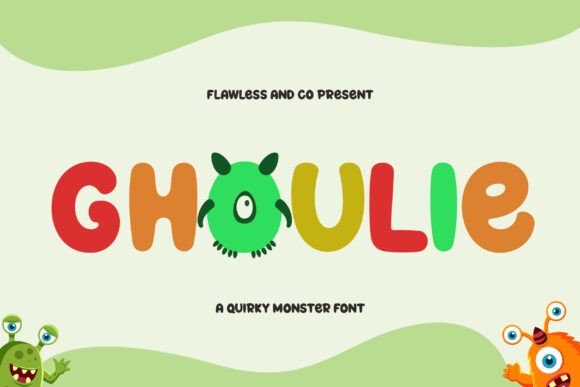
At its core, Ghoulie is a masterclass in balancing "spooky" with "cute." Visually, the typeface is defined by its rounded, bulbous letterforms. The letters feel soft and inflated, lacking the sharp serifs or rigid geometry found in traditional modern typography. However, what sets Ghoulie apart from a standard handwritten font or bubbly script font are the intricate monster-inspired details. You might notice subtle textures, slight irregularities in the baselines, or quirky swashes that mimic horns, teeth, or tails.
The "personality" of the font is mischievous. It feels alive, as if the letters are peeking out at the reader with a cheeky grin. This creates an immediate emotional response. Unlike a neutral typeface that sits quietly in the background, Ghoulie demands attention through its color and energy. It tells the viewer immediately that the content is lighthearted, creative, and accessible. For a brand identity, this visual language translates to warmth and approachability. It signals that a brand doesn't take itself too seriously and is open to fun.
Strategic Applications: Where Ghoulie Fits Best
Knowing where to use a creative font like Ghoulie is just as important as liking how it looks. Because it is a display font with high visual noise, it excels in headlines, logos, and short bursts of text, but it will struggle in long-form paragraphs.
Here are practical scenarios where Ghoulie shines:
- Children’s Publishing and Education: This is the font's natural habitat. For book covers, chapter headings, or educational worksheets, the rounded shapes are friendly and non-threatening to young readers. It supports literacy by making the alphabet feel like a game.
- Event Invitations and Decor: Planning a Halloween party, a monster-themed birthday, or a quirky art show? Ghoulie sets the mood instantly. It works beautifully on print design assets like flyers, banners, and name tags.
- Gaming and Entertainment: If you are designing UI elements for a mobile game, a YouTube thumbnail, or merchandise for a gaming channel, this typeface provides that "arcade" or "cartoon" aesthetic that resonates with that demographic.
- Niche Branding and Packaging: Think about a candy brand, a craft brewery with a playful vibe, or a bakery specializing in monster cookies. Ghoulie can serve as a distinct logo design element. In packaging design, it helps products jump off the shelf by breaking the visual pattern of standard grocery typography.
- Digital Content: For social media graphics, particularly on platforms like Instagram or TikTok where grabbing attention in milliseconds is crucial, the bold, colorful vibe of Ghoulie stops the scroll.
Design Mechanics: Pairing, Hierarchy, and Readability
Using a font like Ghoulie effectively requires a bit of discipline. Because it is so expressive, it can easily overwhelm a design if not managed correctly. The most critical skill here is font pairing.
You should generally avoid pairing Ghoulie with another decorative font, such as a complex script font or a textured handwritten font. The visual styles will clash, creating chaos rather than hierarchy. Instead, let Ghoulie do the heavy lifting for the headlines, and pair it with a clean, legible sans serif font for the body copy. A geometric sans serif or a humanist sans serif provides a neutral canvas that allows the monster details of Ghoulie to pop without making the layout unreadable.
Regarding readability, context is key. At large sizes, the letterforms are distinct and easy to recognize. However, at small sizes, the "monster" details—like rough edges or decorative swashes—can become muddy or pixelated. Therefore, it is not recommended for body text, footnotes, or legal disclaimers. Use it for visual hierarchy: big, bold, and loud for the main message; simple and small for the supporting information.
Technical Versatility: The Power of PUA Encoding
One of the most significant technical advantages of Ghoulie is that it is PUA-encoded (Private Use Areas). For designers, this is a massive quality-of-life feature. Often, when you purchase a premium font, the alternate characters or swashes are difficult to access without advanced design software.
Because Ghoulie is PUA-encoded, every glyph, swash, and alternate character can be accessed via a simple copy-paste from the standard character map on Windows or Mac. This means you don't need to be a master of Adobe Illustrator’s OpenType features to utilize the full range of the font’s personality. You can easily swap out a standard "A" for one with little monster horns or a "G" with a tail, right inside a basic web editor or office document. This accessibility makes it a valuable asset for content creators and hobbyists who might be using platforms like Canva or PicMonkey.
Evaluating the Fit: Licensing and Brand Consistency
Before integrating Ghoulie into your brand identity, it is worth pausing to evaluate the long-term fit. While it is versatile for fun projects, it is highly specific in its theme. If your business is in law, finance, or heavy industrial manufacturing, a monster font might confuse your audience rather than charm them. It is best suited for markets where creativity, youth, and entertainment are valued.
Furthermore, always review the licensing. Since Ghoulie is a commercial font, you need to ensure your license covers your intended usage. If you are a small business owner using it for a logo, you typically need a desktop license. If you are a developer embedding it into an app or a high-traffic website, you may need a webfont or app license. Respecting these boundaries ensures you are using professional design assets legally and ethically.
Ultimately, Ghoulie is more than just a novelty; it is a tool for storytelling. It allows designers, marketers, and publishers to bypass the corporate stiffness of standard editorial design